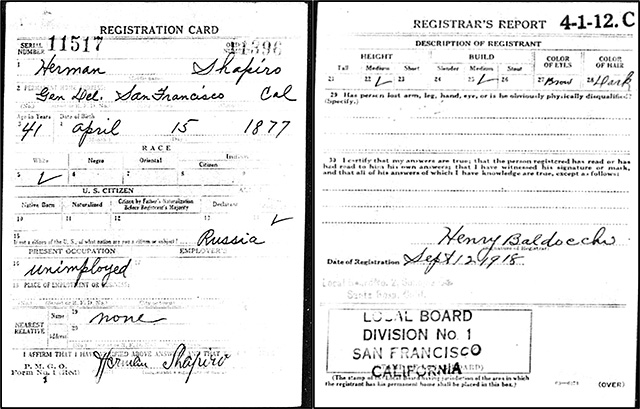
Herman’s WWI draft registration. Photo credit Fillmore Historical Museum.
By Roy Harthorn
[Roy Harthorn is the grandson of Leo Harthorn who was Fillmore City Manager and great-grandson of C. W. Harthorn, from sea captain, store owner, and justice of the peace.]
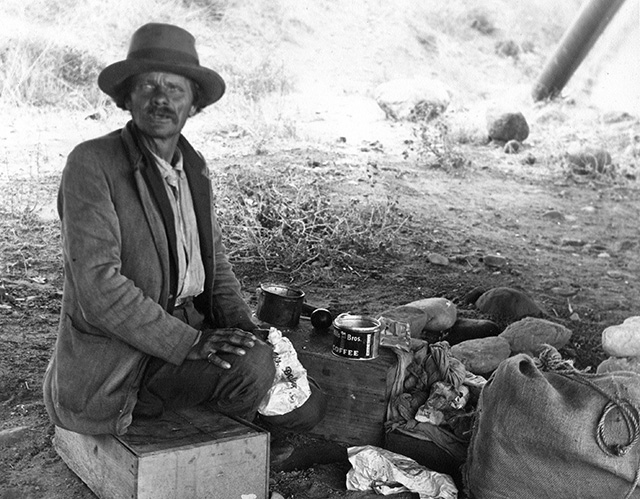
This is a photo (below) of Herman Shapiro or “Sweetie Pie,” a WW1 era Jewish immigrant to the U.S. and refugee from Lithuania, and before that probably Eastern Germany. I had the privilege of meeting Herman in Fillmore as small child; I was only about 3 years old, but the memory is vivid. The attached photo has been on the wall of my office and in my wallet the past 26 years after I found it in the Fillmore Historical Museum. The caption on the back reads “Sweetie Pie was a hobo who served as the overseer of the Fillmore City Dump on Chambersburg Road south of the Bardsdale Bridge in the 1940’s and 1950’s.”
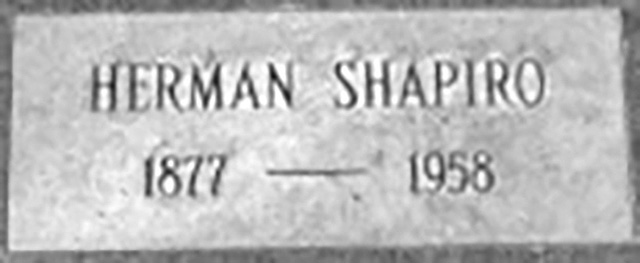
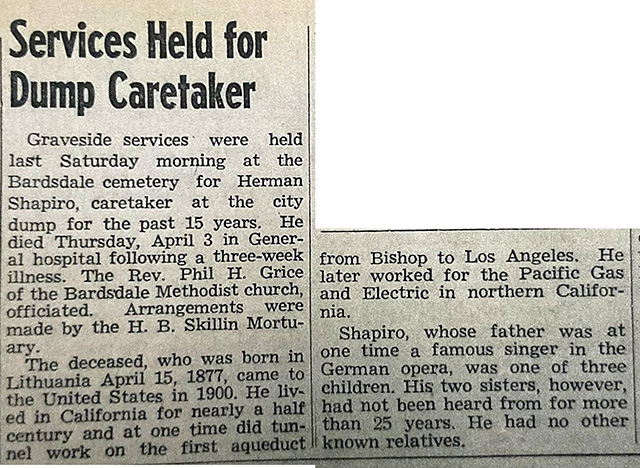
Herman was born on April 15, 1877 and died on April 3, 1958. He is buried in the Bardsdale Cemetery across the river from Fillmore, California. He played a significant role in the lives of many in the Fillmore area as he kept the Fillmore dump a tidier place than it was otherwise. His kindness and generosity effected many other lives including my own.
My grandmother Nellie often took her home cooked meals out to the dump for Herman, who she called Sweetie Pie. She was born in Maine and like my grandfather Leon, was from a long line of New England ancestors and knew her roots back to her family’s old-world homeland in England. Bath, Maine was her birthplace, home to seafarers and world travelers and immigrants like her grandparents.
My grandfather Leon Harthorn, son of the last of his family’s many clipper-ship captains, was a first-generation Californian. He was one of the first foresters employed under Theodore Roosevelt’s then new Forest Reserves. As such he was well suited to become Fillmore’s Public Works Director and later their City Manager.
Leon met Herman camped in the Santa Clara Riverbed and allowed him to camp up above at the city dump in exchange for the work he performed. Herman (as the dump’s de-facto caretaker) was encouraged to salvage useful items that had been thrown away and sell them back to others using the dump. These small sums helped him support his modest lifestyle.
My mother’s parents Harold and Winnie McFadden lived and ranched on the South side of the river just downstream of the dump. They embraced immigrants as well. As citrus farmers, their laborers made their way of life possible and there was mutual respect for and from their workers.
One summer as a 7-year-old, I spent some weeks with both sets of grandparents ahead of the rest of my family’s summer vacation. While there, I recall Grandpa Leon, as City Manager, was asked to address the parents and students (he was bilingual), at Fillmore’s sole elementary school’s graduation ceremony. I was humbled with his ability to fluently address both the English and Spanish speaking audience. He acknowledged he and they were all immigrants. It clearly (to me) made no difference to Leon and Nellie of one’s origin as long as they were willing to study, work, or otherwise contribute to society.
During that time, not all in the community were treated with such dignity, such as Herman who from some, suffered from racist indignities stemming from either their heritage, being refugees, or homeless. Visitors to the dump were not always so appreciative or understanding of Herman.
Fillmore Dump Keeper Says Robbed of $300 Herman Shapiro, Fillmore dump keeper, was robbed of approximately $300 yesterday morning.
Shapiro said 2 men entered the dump about 6 a.m. and said they were looking for some lumber.
Shapiro told sheriff’s deputies one of the men grabbed him and held his arms while the other went through his pockets. The stolen money was in well-worn $5 and 10 bills. After robbing Shapiro, the 2 men left in a light-colored late model car. The car had a white out of state license he said. The robbery, was not reported until 10:35 a.m.
Oxnard Courier July 1957
Herman’s history today is little known except these few facts my genealogical sleuthing has found. To his credit, he registered for the US Army draft during World War I, while his occupation on his draft card is listed as “unemployed,” evidence exists he worked on a railroad chain gang in San Francisco. As a laborer for the railroads, Herman would have traveled on crew cars or hopping freights, and this is how he most likely arrived in Fillmore in the late 40s.
At the dump near its entrance, he built a modest but sturdy shack. From a visit with my father, I recall Herman’s friendliness and my admiration of his simple cabin. He doubtlessly inspired my own childhood interest in building forts, tree houses, and as a teen, a cabin of my own in a nearby barranca, much like Herman’s. These experiences doubtless influenced my interest in the building trades and the codes by which they are governed. Ancient but lasting moral codes of Hammurabi
Over the years the size of Herman’s modest savings grew. Upon his death from cancer in 1958 he bequeathed his $6,000 estate to start college funds for the education of my grandfather’s 12 grandchildren, of which I am one. This amounted to $500 to each of us. His generosity was due in large part to that of my grandparents and the Fillmore Community’s welcoming attitudes.