

|
By Anonymous — Thursday, January 8th, 2009
 The Auto Club The combination of cold temperatures and the recent winter rains, which in some areas of Southern California produced ice, sleet and snowfall, is causing the emergence of new potholes. Potholes, caused by water working its way into asphalt and cracking it, can damage vehicle suspension components and increase the possibility of costly repairs, said Steve Mazor of the Automobile Club of Southern California's Automotive Research Center. Mazor recommends the following tips to help protect vehicles - and drivers - against the jarring experience of hitting a pothole in their path. |

|
By Anonymous — Wednesday, January 7th, 2009
 Ventura County Sheriff's Department Location: Thousand Oaks Police Station Date & Time: Thursday, January 29, 2009 at 6 p.m. until 9 p.m. (and quarterly thereafter.) The Thousand Oaks Police Department will be hosting a program to educate newly licensed and future licensed drivers. Start Smart is a cooperative effort between the California Highway Patrol, Thousand Oaks Police Department, teenage drivers, and their parents. The Start Smart Program is designed to help young drivers and their parents/guardians understand the responsibilities and traffic laws associated with driving a motor vehicle. Start Smart will show how a poor choice behind the wheel can change the lives of everyone involved. Our goal is to raise awareness and reduce the number of teen-related injuries and deaths due to collisions. Interested parents are asked to call Senior Deputy Kelly Roark with the Thousand Oaks Police Department Traffic Bureau at 805-494-8245 for more information and to make a reservation. Space is limited to 25 students and their parents. There is no charge to attend the program. |
|
By Anonymous — Thursday, January 1st, 2009
Among the new laws is AB 2241, limits the issuance of temporary operating permits to those individuals whose vehicles have yet to pass a smog check. The law calls for a $50 fee for one 60-day temporary operating permit only if the vehicle has been tested at a smog station and failed. |
|
By Anonymous — Thursday, January 1st, 2009
The Auto Club With scores of auto travelers hitting the roads this winter during rainstorms and expected snow, the Automobile Club of Southern California reminds motorists that it’s important to be prepared for a possible break down any time, including while vacationing, and even in a properly maintained vehicle. According to the Auto Club, it’s important for drivers to be prepared for breakdowns or emergencies by outfitting their vehicle with food, water, blankets, tools, clothing and other gear in a roadside emergency kit should their vehicle become disabled, or they become lost. Properly stocked, an emergency kit will help drivers repair minor breakdowns, or possibly survive, until help arrives. “Placing several items in an emergency roadside kit in your trunk will help prepare you to handle minor mechanical problems to get yourself back on the road or until the Auto Club or other rescue help arrives,” said Steve Mazor, the Auto Club’s Automotive Research Center Manager. “In this day and age, it’s very helpful to have a fully charged cell phone in your vehicle, along with water, blankets, a jacket and a disposable camera in your glove box in the event that you require a tow, 9-1-1 emergency assistance, or documentation of a crash,” added Mazor. The Auto Club recommends the following items be included in a basic roadside emergency kit for a vehicle: Basic Roadside Emergency Kit Checklist: |
|
By Anonymous — Friday, December 26th, 2008
The Auto Club New laws taking effect on Jan. 1 in California will ban text messaging while driving, regulate the positioning of GPS devices in vehicles, and increase fees levied on motorists in a variety of categories, according to the Automobile Club of Southern California. Senate Bill 28 prohibits drivers from text messaging or e-mailing while driving. Fines for violating this law are at least $76 (including penalties) for a first offense and about $190 for subsequent offenses, depending on the county in which the violation occurred. "The Auto Club supported this law because we believe it will help reduce the number of traffic crashes in the state," said Alice Bisno, the Auto Club's senior vice president for public affairs. "We encourage motorists to avoid all distractions while driving." The Auto Club also sponsored a law in response to a member request to ensure that motorists are not unfairly penalized for parking violations that they did not commit. AB 2401 prevents a car owner from being held liable for a parking ticket or toll-evasion violation issued against a vehicle before he or she became the owner of the vehicle. Sufficient proof of non-ownership includes, but is not limited to, a copy of the sales agreement showing the date of the vehicle ownership transfer. Another new law, SB 1567, requires portable GPS devices that are affixed to a vehicle windshield to be placed either in a seven-inch square in the lower right corner of the windshield or in a five-inch square in the lower left corner, while the vehicle is being driven. Motorists may still mount a GPS device on top of the dashboard as long as it doesn't block their view of the road. The device must not be placed so that it interferes with the deployment of an air bag. The fine for a violation is approximately $108 including penalties, depending on the county. Most of the other new driver-related laws and regulations taking effect Jan. 1 involve fee increases. "Unfortunately, this year's budget crunch in Sacramento resulted in a number of fee increases that target motorists," Bisno said. "It was perhaps inevitable that fees would be raised in light of the budget crisis, but the Auto Club opposes fee increases that disproportionately fall on drivers for non-motorist uses." One law that the Auto Club opposed was SB 1407, which raises surcharges on traffic tickets by $35, "fix-it" tickets by $15, parking tickets by $3, and the court cost to attend traffic school by $25. The fee increases are being used to help pay for the construction and rehabilitation of courthouses. The vast majority of tickets are paid by mail or through bail forfeiture and most violators never set foot in a courthouse. The Auto Club opposed the measure because it is inequitable to place the burden of financing courthouse construction disproportionately on drivers who do not use court facilities. Also, any vehicle purchased outside of California and brought into the state within 12 months of the purchase date is subject to the payment of a use tax (equivalent to a sales tax). Previously, the law imposed this tax only if the vehicle was brought into the state during the first 90 days of ownership. An owner can avoid paying this use tax by providing documentary evidence that he or she intends to use the vehicle outside the state. The state expects to receive approximately $20 million per year from this change in the law. The Automobile Club of Southern California, the largest member of the AAA federation of motor clubs, has been serving Southern California since 1900. Today, the Auto Club's members benefit by roadside assistance, insurance products and services, travel agency, financial products, automotive pricing and buying programs, automotive testing and analysis, trip planning services and highway and transportation safety programs. Information about these products and services is available on the Auto Club's Web site at www.AAA.com. |
|
By Anonymous — Wednesday, December 17th, 2008
Lower gas prices are putting a little more green in shoppers’ pockets for them to spend this holiday season, but economic concerns will still make many consumers want to stretch their shopping budget dollars as much as possible. As one of the largest membership organizations in the Southland, the Automobile Club of Southern California has been able to negotiate discounts with hundreds of retail outlets and online merchants throughout the U.S., providing its members with savings that can significantly extend their holiday shopping budgets. Last year, the AAA Show Your Card & Save program saved consumers nearly $1.2 billion through member discounts. The Auto Club has several tips to help shoppers save money both on gifts and necessities during the holiday season, and maximize value when buying gifts: |
|
By Anonymous — Thursday, December 11th, 2008
The Auto Club An analysis of California drinking and driving data from 1998 to 2007 shows that alcohol-related crashes involving young adult women drivers soared, according to the Automobile Club of Southern California. The Auto Club found that women drivers ages 21-24 involved in fatal and injury alcohol-related crashes more than doubled – rising by 116%. The Auto Club analysis also showed their male counterparts’ crashes during the same period rose 39%. The analysis also shows that young adult women drivers, passengers and pedestrians’ alcohol-related deaths and injuries have risen substantially – by nearly half since 1998 when 1,037 women ages 21-24 were killed and injured in alcohol-related crashes. In 2007, the level had risen by 46% to 1,515 in 2007, according to the Auto Club. The Auto Club analysis of California Highway Patrol data of the last 10 years shows that women far outpaced men the same age in alcohol-related deaths and injuries. Alcohol-related deaths and injuries of men ages 21-24 increased by 18% compared to the 46% for women. The findings were announced today at the first Orange County Drinking and Driving Community Forum. Attending the forum were traffic safety, health care and law enforcement professionals from around the Southland who heard presentations from local, state and national experts on various aspects of impaired driving. The Orange County Drinking and Driving 2008 Community Forum is a partnership among the Auto Club, the Costa Mesa DUI Task Force, the County of Orange Health Care Agency Alcohol and Drug Education Prevention Team (ADEPT) and the UCI Center for Trauma and Injury Prevention Research. The Auto Club analysis also showed a notable increase in alcohol-related crashes among female drivers 18-20. Women drivers ages 18-20 were involved in 74% more alcohol-related fatal and injury crashes in 2007 than in 1998. Male drivers increased their crashes by 27%. About 2,200 California drivers ages 18-20 are in alcohol-related fatal and injury crashes annually. CONTINUED » |
|
By Anonymous — Friday, December 5th, 2008
The Auto Club Gas price averages throughout Southern California dropped below $2 and kept on heading downward this past week, according to the Automobile Club of Southern California’s Weekend Gas Watch. The average price of self-serve regular gasoline in the Los Angeles-Long Beach area is $1.912 per gallon, which is 19.7 cents less than last week, 90 cents lower than last month, and $1.44 under last year. In San Diego, the price is $1.873, which is 17.9 cents under last week’s price, 89 cents below last month, and $1.50 lower than last year. On the Central Coast, the average price is $1.981, down 19.4 cents from last week, 86 cents below last month, and $1.44 below last year. In the Inland Empire, the average per gallon price is $1.876, which is 17.8 cents under last week, down 88 cents from last month, and $1.46 less than last year. “Local gas prices have been dropping by double digits each week for nearly two months in a row,” said Auto Club spokesperson Jeffrey Spring. “It’s hard to know when or where price decreases will end, but gas price drops have leveled off this week in states that are paying in the $1.55-$1.65 range at the pump, such as Missouri, Kansas and Oklahoma.” |
|
By Anonymous — Friday, November 21st, 2008
The Auto Club More than 3.2 million Southern Californians are expected to travel over this holiday weekend – a decrease of more than 2 percent from last Thanksgiving, according to the Automobile Club of Southern California. About 82 percent of local Thanksgiving travelers – or 2.68 million people – will go by car to their holiday destinations, also a decrease of more than 2 percent over last year. Another 344,000 Southland residents are expected to fly to their destinations – a 5 percent decrease, while 222,000 will take a cruise, train or bus. “There’s no doubt that recent economic uncertainty is impacting Thanksgiving travel,” said Auto Club spokesman Jeffrey Spring. “But the good news for travelers is that this is the cheapest 2008 holiday for car travel, with gas prices about half of what they were over the Memorial Day and Fourth of July holidays.” Statewide, 5.2 million people are expected to take holiday trips this weekend, also a decrease of more than 2 percent over last year. Of those, 4.3 million are expected to drive and 551,000 are projected to take air trips. Nationally, a decrease of more than 1 percent in travel is expected, with 41 million Americans expected to take Thanksgiving trips. Southern Californians will mainly stay close to home over Thanksgiving, although some are taking longer-distance trips because of the four-day weekend. The top five destinations for Southern California travelers, according to a survey of the Auto Club’s AAA Travel agents, are: Around the state, travelers can expect to pay prices near $2 a gallon for gasoline – the lowest Thanksgiving gas prices since 2004. The Auto Club advises motorists to plan their routes by calling the California Highway Information Number at 1-800-427-7623 for interstate and state route lane closures and highway closures. The information is updated hourly. More Auto Club tips for holiday travelers include: |
|
By Anonymous — Thursday, November 13th, 2008
The Auto Club Gas prices took their biggest nosedive ever over the past month, plunging by about 25 percent or an average of three cents a day in most of Southern California, according to the Automobile Club of Southern California monthly Fuel Gauge Report. The Southern California November average price for regular self-serve gasoline fell 88 cents to $2.569 from the October average of $3.449, and is now $2.02 below the all-time monthly record high of $4.585 set in July. In November 2007, the monthly Fuel Gauge Report average for Southern California was $3.355 – 79 cents higher than the current monthly average. The statewide average price of $2.522 is nearly 94 cents lower than the October average of $3.457. The state’s lowest average price is in Stockton, where regular sells for $2.191. Bishop has the highest price average in the state at $3.119. Nationally, the average price of $2.220 also has plunged by 94 cents from the October average of $3.163. Alaska has the highest state average price at $3.361, and Missouri has the lowest state average price, at $1.915. Four states now have price averages below $2 a gallon, and only Alaska and Hawaii have averages above $3. “With gas prices that are nearly 25 percent cheaper than this time last year, Thanksgiving travel will be a more affordable option for many families,” said Auto Club spokesperson Jeffrey Spring. |
|
By Anonymous — Thursday, November 13th, 2008
DETROIT – General Motors Corp. (NYSE: GM) today announced it is taking further actions to improve liquidity and reduce structural cost in response to deteriorating global economic conditions, tight credit market conditions and a rapid retraction of sales in the auto industry. “Volatility in the world’s financial markets, tightening of consumer and business credit and historically-low consumer confidence has created a very challenging environment ,” said Rick Wagoner, GM chairman and chief executive officer. “Given the current lack of credit availability we must take further difficult ‘self-help’ actions .” Over the past several years, GM has been taking major actions to restructure its business and position it for long-term growth, making dramatic reductions in structural cost, revitalizing its product portfolio with award-winning vehicles, growing aggressively in emerging markets around the world and making demonstrable strides in advanced technology leadership (link to release). As part of its ongoing restructuring, on July 15, 2008 GM outlined a number of initiatives aimed at improving liquidity by an estimated $15 billion through 2009. Those initiatives included internal operating actions within the company’s control that are estimated at $10 billion, asset sales estimated at $2-4 billion and capital market activities targeted at $2-3 billion (link to release). To date, the $10 billion in internal operating actions have either been completed or are on track for full execution by the end of 2009. GM’s assets currently being assessed for potential sale include the Hummer vehicle business and brand and its ACDelco all-makes aftermarket parts business, which has distribution channels in more than 100 countries. GM is also evaluating strategic options for its technical and manufacturing center in Strasbourg, France. GM is also analyzing other potential asset sales. Despite the seizing up of the credit markets, GM completed some capital market transactions (link to release) in September to improve the company’s liquidity by $500 million by year-end 2009. While GM has unencumbered assets of more than $20 billion that it could potentially use as collateral for a secured debt offering, the U.S. credit markets remain inaccessible, and the contagion effect on other financial markets around the world provides limited alternatives. Accordingly, t he timing of the $2-3 billion of capital market financing GM initially targeted remains uncertain. CONTINUED » |
|
By Anonymous — Thursday, October 23rd, 2008
Scott Malone writing for Reuters reported that General Electric Co is stepping up its investment in developing new battery technologies for autos as it looks to increase its role in electrifying cars -- one of the key strategies to boost fuel efficiency and reduce carbon dioxide emissions. The U.S. conglomerate is working with U.S. automaker Chrysler to secure government funding to develop a system to electrify larger passenger vehicles and has raised its investment in A123 Systems Inc, which makes batteries for cars and electric devices, to $55 million. "The trend toward electrification is pressing and inevitable," said Mark Little, senior vice president and director of GE's global research center in Niskayuna, New York. GE and Chrysler are teaming up to develop plug-in hybrid electric cars that use two batteries -- lithium-ion, which GE researchers said is better-suited for creating short bursts of power when starting a car -- and another using sodium-metal halide technology, which GE contends is preferable for producing long-term, steady power, like at cruising speed. The conglomerate and the automaker are seeking $10 million in funding from the U.S. Department of Energy to develop the system, GE officials said. If the funding is approved, the two companies would match it. Lithium-ion batteries, common in small consumer electronics like cell phones and laptop computers, are what automakers are focusing on for the next generation of electric vehicles, including General Motors Corp's upcoming all-electric Chevrolet Volt and Mercedes-Benz's planned S-Class hybrid. The current generation of hybrids on the road, including Toyota Motor Corp's Prius, rely on nickel-metal batteries that are larger and heavier than the lithium-ion variety. CONTINUED » |
|
By Anonymous — Friday, September 26th, 2008
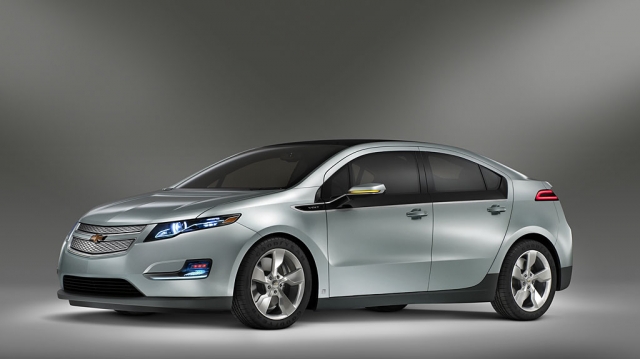
DETROIT - General Motors launched its next 100 years today by unveiling the much-anticipated production version of the Chevrolet Volt - a vehicle that delivers up to 40 miles of gasoline- and emissions-free electric driving, with the extended-range capability of hundreds of additional miles. "Revealing the production version of the Chevy Volt is a great way to open our second century," said Rick Wagoner, GM Chairman and CEO. "The Volt is symbolic of GM's strong commitment to the future ... just the kind of technology innovation that our industry needs to respond to today's and tomorrow's energy and environmental challenges." Form follows function Because aerodynamics plays a key role in maximizing driving range, GM designers created an aerodynamically efficient design for the production vehicle. Many of the design cues from the concept vehicle endure in the production Volt, including the closed front grille, athletic stance, rear design graphics, outside rearview mirrors and more. The Volt's rounded and flush front fascia, tapered corners and grille are functional, enabling air to move easily around the car. In the rear, sharp edges and a carefully designed spoiler allow the air to flow off and away quickly. An aggressive rake on the windshield and back glass help reduce turbulence and drag. Working closely with GM aerodynamicists to shape the Volt, design and engineering teams developed one of the most aerodynamic vehicles in GM's history. They spent hundreds of hours with the Volt in GM's wind tunnel, testing and re-testing parts such as the front and rear quarter panels, rear spoiler, rockers and side mirrors. Aerodynamic improvements enabled GM to reach the Volt's target of driving up to 40 miles (based on EPA city cycle) without using gasoline or producing emissions. Inside, the Volt offers the space, comfort, convenience and safety features that customers expect in a four-passenger sedan, and it delivers them in a variety of interior color, lighting and trim options unlike any offered before on a Chevrolet sedan. Modern controls and attractive materials, two informational displays, and a touch-sensitive infotainment center with integrated shifter distinguish the Volt's interior from other vehicles in the market. Some of Volt's interior technological features include: Driver-configurable, liquid crystal instrument display The Volt uses electricity to move the wheels at all times and speeds. For trips up to 40 miles, the Volt is powered only by electricity stored in its 16-kWh, lithium-ion battery. When the battery's energy is depleted, a gasoline/E85-powered engine generator seamlessly provides electricity to power the Volt's electric drive unit while simultaneously sustaining the charge of the battery. This mode of operation extends the range of the Volt for several hundred additional miles, until the vehicle's battery can be charged. Unlike a conventional battery-electric vehicle, the Volt eliminates "range anxiety," giving the confidence and peace of mind that the driver will not be stranded by a depleted battery. The Chevrolet Volt can be plugged either into a standard household 120v outlet or use 240v for charging. The vehicle's intelligent charging technology enables the Volt's battery to be charged in less than three hours on a 240v outlet or about eight hours on a 120v outlet. Charge times are reduced if the battery has not been fully depleted. At a cost of about 80 cents per day (10 cents per kWh) for a full charge that will deliver up to 40 miles of electric driving, GM estimates that the Volt will be less expensive to recharge than purchasing a cup of your favorite coffee. Charging the Volt about once daily will consume less electric energy annually than the average home's refrigerator and freezer units. Charge out of driving GM estimates that the Volt will cost about two cents per mile to drive while under battery power compared to 12 cents per mile using gasoline priced at $3.60 per gallon. For an average driver who drives 40 miles per day (or 15,000 miles per year), this amounts to a cost savings of $1,500 annually. Using peak electric rates, GM estimates that an electrically driven mile in a Chevy Volt will be about one-sixth of the cost of a conventional gasoline-powered vehicle. The cost savings are even greater when charging during off-peak hours, when electric rates are cheaper. The Chevrolet Volt is expected to be built at GM's Detroit-Hamtramck manufacturing facility, subject to GM successfully negotiating satisfactory government incentives. Production is scheduled to begin late 2010 for models in the United States. Pricing has not been announced. Visit media.gm.com/volt for more information. |
|
By Anonymous — Wednesday, August 27th, 2008
The winner of the 2009 Green Car of the Year(R) (GCOY) award will be announced Nov. 20, 2008 during the Los Angeles Auto Show's Press Days. Green Car Journal, the leading automotive environmental magazine, initiated this annual award in 2005 and it has continued to grow in significance as consumer demand for more fuel efficient and environmentally positive vehicles has increased exponentially. "Each year we choose the LA Auto Show to make this important announcement because California -- and especially the greater Los Angeles region -- has historically been the epicenter for both automotive and environmental innovation, and that's what this award is all about," said Ron Cogan, editor and publisher of Green Car Journal and editor of GreenCar.com. The Green Car of the Year(R) award is designed to recognize environmental achievement in the automotive industry. After considering scores of new vehicle models that raise the bar in environmental performance, five automobile nominees will be identified in advance of the press conference. Last year, the Chevrolet Tahoe Hybrid was named Green Car Journal's 2008 Green Car of the Year(R), with jurors noting that a Hybrid SUV achieving a city mpg rating on par with today's mid-size cars ends the argument that efficiency and vehicle choice are incompatible. The previous year's winner was the Toyota Camry Hybrid and the inaugural 2006 Green Car of the Year distinction was awarded to the Mercury Mariner Hybrid. CONTINUED » |
|
By Anonymous — Wednesday, August 20th, 2008
The Volkswagen compact sport utility vehicle Tiguan received the Insurance Institute for Highway Safety (IIHS) TOP SAFETY PICK award for 2008, the highest rating possible from the non-profit research organization. The annual award recognizes vehicles that perform best in protecting passengers in the Institute's front, side and rear crash test evaluations, and includes only vehicles with electronic stability control (branded Electronic Stabilization Program on Volkswagen vehicles) and head protection airbags. "In the latest test, the Tiguan's performance is a standout," said Adrian Lund, president IIHS. "It sailed through the front and side crash tests without a single downgrade for structure or measures of injury likelihood recorded on the dummy," Lund added. "We are extremely proud when organizations like IIHS recognize the hard work of our engineers who are dedicated to the safety of our customers," said Stephfan Jacoby, president and CEO, Volkswagen Group of America. "This award is further validation of Volkswagen's Prevent and Preserve Safety System approach to vehicle safety." The Prevent and Preserve Safety System portfolio for MY2009 consists of 45 safety features, all of which contribute to protecting the driver and passengers as well as possible, helping avoid crashes and keeping the severity and consequences of possible crashes to a minimum. The Tiguan comes standard with the Prevent and Preserve Safety System, including ESP and six airbags, with rear seat airbags as an option. Tiguan is available in three trim levels, S, SE, and SEL. It is based priced at $23,200, reflecting the Volkswagen brand commitment of providing both tremendous value and affordable German engineering. Tiguan offers EPA fuel economy of 19 mpg in the city and 26 mpg on the highway. Tiguan, the GTI of Compact Sport Utility Vehicles, also features the "fun to drive" handling and performance expected from a Volkswagen. Tiguan features a standard 2.0L TSI(R) engine that delivers turbo-charged acceleration while still delivering responsible fuel efficiency. This award winning turbo-charged four-cylinder power plant delivers 200 horsepower and 207 lbs. -ft. of torque. The combination of four valves per cylinder, direct fuel injection and turbo- charging delivers the optimum balance of power and economy. European tuned suspension enables connected handling, while also providing a smooth and compliant ride. Both front wheel drive and 4Motion(R) all-wheel-drive is available to suit any weather or road condition. Tiguan, like all current 2009 model year Volkswagen vehicles, is included in the no-charge Carefree Maintenance Program. Under this program all of Tiguan's scheduled maintenance, as described in its maintenance booklet, is covered for the length of the New Vehicle Warranty-three years or 36,000 miles, whichever occurs first. Volkswagen of America, Inc. Founded in 1955, Volkswagen of America, Inc. is headquartered in Herndon, Va. It is a subsidiary of Volkswagen AG, headquartered in Wolfsburg, Germany. Volkswagen is one of the world's largest producers of passenger cars and Europe's largest automaker. Volkswagen sells the Rabbit, New Beetle, New Beetle convertible, GTI, Jetta, GLI, Passat, Passat wagon, Eos, Tiguan and Touareg through approximately 600 independent U.S. dealers. Visit Volkswagen of America online at vw.com. |
|
By Anonymous — Wednesday, August 13th, 2008
New generation of world-class vehicles to be built in Detroit
TRAVERSE CITY and AUBURN HILLS, Mich., Aug. 13 -- Chrysler LLC announced today that it will invest approximately $1.8 billion in new vehicle programs, including a significant expansion and upgrade at its Jefferson North (Detroit) Assembly Plant to ready it for future production, starting in 2010. The announcement was made by Tom LaSorda, Chrysler LLC Vice Chairman and President, during a speech at the 2008 Management Briefing Seminars in Traverse City, Michigan. "This investment in our future products and at Jefferson North will enable the Company to produce a future generation of vehicles more efficiently, with world-class quality and an improved environmental footprint," said Tom LaSorda. "Furthermore, this commitment reinforces the long-standing partnership between Chrysler LLC, the City of Detroit and the State of Michigan." "A strong Chrysler is important for Michigan and Michigan workers, and we are pleased to cooperate with them on this project," said Governor Jennifer Granholm. "This expansion will continue a valuable, long-term partnership that has helped keep Michigan the automotive capital of North America." Plant and Product Advancements The total program investment will go towards product development functions, as well as new, state-of-the-art manufacturing systems in the plant. This investment provides for the design, development, components and supplier support associated with the new vehicle programs. "We believe the Jefferson North makeover will give the facility and our Company the upper hand on how responsive we can be to shifts in consumers' needs and changing market demands," said Frank Ewasyshyn, Chrysler LLC Executive Vice President of Manufacturing. "We also believe this will be achieved while continuously improving the quality of our vehicles that will be produced in Detroit." Jefferson North will undergo a 285,000 square foot building expansion to replace the existing body shop, which will give the facility an all-new level of manufacturing flexibility for multiple product capability. In addition, changes throughout paint and assembly operations will accommodate vehicles of various sizes and dimensions. Material handling and other plant functions also will be improved. Plant employees will benefit from new levels of involvement and training to help complete the plant transformation. Much of the critical work required for facility and equipment preparation and installation will be accomplished by employees from the plant, a result of collaborative work between Chrysler and the UAW. "This is an important day for the future of the UAW and Chrysler LLC, and we are pleased to partner with Chrysler to help maintain jobs in Michigan," said General Holiefield, UAW Vice President and Director for the Chrysler Department. "Although we are in the midst of challenging times, the strong relationship between Chrysler and the Union will contribute toward our long-term success." Green Initiatives Multiple "green" initiatives will be employed at Jefferson North. Each of these additions will result in energy savings, as well as a brighter, cleaner and more ergonomically sound workplace for employees. Plus, these advancements will improve the environmental footprint of the facility by reducing carbon emissions, solid waste and raw material consumption while also helping to green the outside grounds of the plant. These include: -- Energy-efficient fluorescent lighting fixtures and a state-of-the-art energy management system; -- Air filtration systems to improve employee comfort and workplace cleanliness; -- Decanting technology, which will utilize paint sludge as an energy source, reducing emissions and solid waste; -- Electric-servo weld guns in the new body shop to improve welding quality for the vehicle bodies, while also producing quieter operations; -- Replacing unused asphalt parking areas with grass to reduce heat generation and improve appearance; -- Utilizing reusable paint clips that hold doors in place during the paint process and reusing parts racks, resulting in a reduced raw material consumption; and -- Trailer cubing and rack density improvements to reduce fuel consumption and transportation costs. The energy savings resulting from the sludge operations, filtration systems, lighting and servo welding alone are anticipated in total to save several dollars per vehicle built, while helping to have a cleaner, brighter workplace. Commitment to Employees and Detroit Chrysler LLC continues to be one of the leading employers in Detroit and Michigan. In addition to investing and expanding the plant itself, the new investment will help maintain jobs in Detroit. Chrysler currently has eight facilities in Detroit including Detroit Axle; Jefferson North Assembly; Mack Engine I; Mack Engine II; Mt. Elliott Tool & Die; Plymouth Rd. Office Complex; Conner Ave. Assembly; and Chrysler Transport. About Jefferson North Assembly Plant The 2.7 million square foot Jefferson North Assembly Plant was built in 1991. The Company's current Jeep(R) Grand Cherokee has been produced there since its introduction in 1992. The facility was expanded once in 1999, and the plant currently produces the Jeep Grand Cherokee and Jeep Commander. Jefferson North Assembly Plant is a member of U.A.W. (United Auto Workers) Locals #7, #889 and #412. |
|
By Anonymous — Wednesday, August 6th, 2008
Safety campaign aims to curb unsafe driving in school zones, neighborhoods
The Auto Club Fifty-six million children across the country begin heading back to school this month, and AAA is urging motorists to slow down and stay alert in neighborhoods and school zones with its 75th annual School's Open - Drive Carefully campaign. Unsafe driving in school zones AAA's School's Open - Drive Carefully campaign hopes to curb a trend of unsafe driving behavior in school zones and neighborhoods that can result in children's injury and sometimes death. Pedestrian injury is the second leading cause of injury-related death in the United States for children ages 5 to 15, according to the Centers for Disease Control and Prevention. More than 33,500 children were treated in emergency rooms for pedestrian-related injuries in 2005. Nearly half (45 percent) of vehicles observed in school zones and residential neighborhoods during a 2003 national observational survey did not come to a complete stop at stop signs. -- 37 percent rolled through a stop sign AAA targets motorists with safe driving message AAA's School's Open - Drive Carefully campaign encourages motorists to stay alert in areas where children are present by its local clubs utilizing posters, magnets, bumper stickers, handouts, media outreach and other community initiatives to reach motorists. For a second year, AAA will also partner with International Speedway Corporation (ISC) to remind race fans at upcoming Sprint Cup Series events that School's Open - Drive Carefully. Starting at this weekend at Watkins Glen International, AAA's brightly colored school bus icon can be spotted around the track. The campaign will continue during Sprint Cup Series events this fall at Richmond International Raceway, Kansas Speedway, Talladega Superspeedway and Martinsville Speedway. Safety tips for motorists, parents and students online AAA offers comprehensive lists of tips for motorists, parents and students on school zone, school bus, pedestrian and bicycle safety online at AAA.com/PublicAffairs. Some key tips for motorists on the site include: -- Slow down in or near school or residential areas, and be sure to come to a complete stop at all intersections. -- Look for clues such as AAA School Safety Patrol members, crossing guards, bicycles and playgrounds which indicate children could be in the area. -- Scan between parked cars and other objects for signs that children could dart into the road. -- Always stop for school buses that are loading and unloading students. It's the law. -- Leave a little early so you are not rushed as you travel to work or school. -- Drive with your headlights on - even during the day - so children and other drivers can see you. |
|
By Anonymous — Wednesday, July 23rd, 2008
Employees from 74 Chrysler Jeep® Superstores and Motor City Dodge Dealers partner with the Sterling Heights Community Foundation to build a safe, new playground
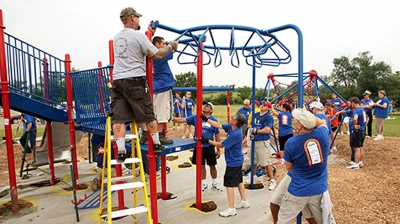
Auburn Hills, Mich. - More than 250 volunteers from the Chrysler Jeep® Superstores, Motor City Dodge Dealers, The Chrysler Foundation, the Sterling Heights Community Foundation, residents of the Sterling Heights community and organizers from KaBOOM! came together on Saturday, July 19, to build a new playground at Delia Park. The park is located in the city of Sterling Heights, which was recently named among the top 100 cities by Best Life magazine in 2008 as the "Best Places to Raise a Family." Designed by local children, the playground replaces existing equipment at the park that was outdated, in need of replacement and unsuitable for children to play on. The Chrysler Jeep Superstores and Motor City Dodge Dealers spearheaded the build effort that will provide 40,000 children annually with a new, safe place to play. "Every child deserves the joy of play and friendship in their lives; and every family deserves the support that a strong community network provides," said Jim Schebil, president of the Chrysler Jeep Superstores Advertising Association. "This project provides these things and more to the City of Sterling Heights and is directly in line with the Chrysler Jeep Superstores' long history of strong hometown community involvement." Planning for the playground began at a Design Day event held in May 2008. Local children and community leaders met with organizers from KaBOOM! and Chrysler to develop their "dream" playground. The children's drawings were used to create the final playground design. "We are so excited to have this playground built at Delia Park with the help of KaBOOM!, Chrysler Jeep Superstores and Motor City Dodge Dealers," said Sterling Heights Mayor Richard Notte. "A playground represents what a park is all about. This playground says that Delia Park is a park that welcomes vibrant, energetic children ready to play on equipment created especially for them." The project is the seventh of 25 playgrounds scheduled to be built across the country this year by KaBOOM!, The Chrysler Foundation, Chrysler Financial and Chrysler, Jeep or Dodge dealerships. The playground is also one of more than 225 builds KaBOOM! will lead across the country in 2008, in an effort to provide an enjoyable place to play within walking distance of every child in America. "The Motor City Dodge Dealers are excited to support an effort that puts our children and community first," said Motor City Dodge Dealers President Mark Snethkamp. "Our stores have been vital members of the communities they serve for decades, so we understand that bringing people together in a positive and fun way is the basic building block needed to create strong communities." The Chrysler Foundation KaBOOM! |
|
By Anonymous — Wednesday, July 16th, 2008
 Volkswagen WOLFSBURG – Volkswagen is setting out to build a plant in Chattanooga, Tennessee, where vehicle production will be due to commence in early 2011. The supervisory board of Volkswagen AG today approved the plans and an investment volume of up to 1 billion USD (around 620 million euro). The Group’s management board had previously pinpointed Chattanooga as the site for its new plant. “The USA market,” said Prof Martin Winterkorn, CEO of Volkswagen AG, “is an important part of our volume strategy and we are now very resolutely accessing that market. Volkswagen will be extremely active there.” The first stage of construction is designed to provide annual capacity for the complete production of 150,000 automobiles, including body-production, paint-shop and assembly operations. A cutting-edge modular production system at the plant will enable maximum flexibility. The first vehicle to be manufactured there will be a new midsize sedan tailored specifically to the US market. Volkswagen itself will employ a staff of approximately 2000 at the site over the medium term, while additional jobs will be created in the supplier and logistics sectors. "This plant represents a milestone in Volkswagen’s growth strategy," says Prof Winterkorn. "We will be selling 800,000 Volkswagen p.a. in the USA by 2018, and this new site will play a key role." Volkswagen says the plant will help to permanently alleviate exchange-rate fluctuations. "This, along with our growth strategy, is a prerequisite for the economic success of the company in the dollar region." That success apparently includes having customers in the US come to perceive the company as a domestic manufacturer. Volkswagen originally short-listed 25 potential sites for its US plant. The management board chose Chattanooga because it outperforms (though only slightly) the next-best candidate sites in terms, most notably, of providing an existing infrastructure of components suppliers, of disposing over a qualified workforce and of the availability of around 550 hectares of developed property with direct transport connections. Prof Winterkorn added: "We look forward to establishing an important mainstay for ourselves when we become the biggest European carmaker there." |
|
By Anonymous — Sunday, July 13th, 2008
With urban populations growing, active safety technologies may play a greater role reducing accidents on crowded city streets
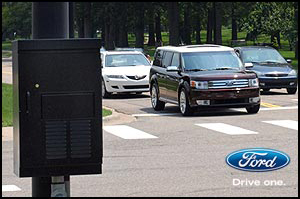 The smart intersection, established near Ford's Research & Innovation Center in Dearborn, communicates with specially equipped test vehicles to warn drivers of potentially dangerous traffic situations. DEARBORN, Mich. - Ford Motor Company researchers today unveiled one of the first privately funded "smart intersections" in North America, a key step toward leveraging GPS technology and wireless infrastructure-to-vehicle communications to reduce traffic accidents and ease congestion. The smart intersection, established near Ford's Research & Innovation Center in Dearborn, communicates with specially equipped test vehicles to warn drivers of potentially dangerous traffic situations, such as when a vehicle is about to run through a red light. The intersection is outfitted with technology that can monitor traffic signal status, GPS data and digital maps to assess potential hazards, and then transmit the information to vehicles. Once the in-vehicle computer receives data indicating a potential hazard, it can instantly warn drivers through visual and audio alerts. "Ford has the most five-star safety-rated vehicles than any other automaker and we want to build on that by offering smart active safety solutions for drivers," said Dr. Priya Prasad, Ford safety technical fellow. The smart intersection project will accelerate Ford's research into proprietary "active safety" technologies as it continues development of a common architecture and standards for smart intersections together with General Motors Corp., Honda Motor Co., Daimler AG, Toyota Motor Corp., the federal government, and local and county road commissions. The joint public-private effort is known as Crash Avoidance Metrics Partnership (CAMP). "New technologies such as wireless communications and GPS-enabled navigation systems may enable us to offer more safety features in the future," said Jeff Rupp, manager, Active Safety, Research and Advanced Engineering. The active safety initiative comes as research shows that 40 percent of all traffic accidents and 20 percent of crash-related fatalities occur at intersections. The issue is expected to become more pressing as the global population migrates to large urban areas. The U.S. National Intelligence Council predicts about two-thirds of the world will be living in city regions by 2015, up from 50 percent today. According to National Highway Traffic Safety Administration (NHTSA) data for 1997-2004, 84 percent of fatalities in signalized intersections and 37 percent of fatalities in stop sign junctions occurred in urban settings. Ford's new smart intersection transmits several pieces of data to the test vehicle, including a digital map of the intersection, six additional maps of surrounding stop sign intersections and crosswalks, lane-specific GPS location, as well as traffic light status and timing information. Once the information is received, the vehicle's collision avoidance system may be able to determine whether the car will safely cross the intersection or if it needs to stop before reaching it. If the system determines the need to stop and senses that the driver is not decelerating quickly enough, it issues visual and audio warnings to the driver. "This technology has the potential to augment vehicle navigation systems to enhance safety by helping people who are distracted, drowsy or cannot see the traffic light due to a visual obstruction," said Joe Stinnett, lead technical engineer, Active Safety Research and Advanced Engineering. "Our research is helping to identify the kinds of warnings that drivers may find both more effective and easier to understand." Infrastructure-to-vehicle communications could directly ease congestion by reducing crashes. According to the Texas Transportation Institute's 2007 Urban Mobility Report, traffic congestion continues to worsen in American cities of all sizes, annually wasting nearly 3 billion gallons of fuel as recently as 2005 - that's 58 fully-loaded supertankers. According to TTI analyst David Schrank, approximately half of traffic delays are caused by accidents, breakdowns and road debris. A vehicle equipped with a collision avoidance system could act as a traffic probe, and communicate its presence and travel history when it encounters a smart intersection, said Mike Shulman, technical leader, Ford Active Safety Research and Advanced Engineering. Such capability could complement a feature already available on Ford Motor Company vehicles, SIRIUS Travel Link, which combines real-time traffic speed and flow data by satellite with accident and incident information to allow the user to navigate around congested areas. "If smart intersections were widely available, such traffic information could be combined with information from other vehicles and would complement and enhance the information that Travel Link already provides," Shulman explained. "It could even include future vehicle travel, based on a destination entered into the navigation unit or past trips." Ford's Active Safety Research team is quick to point out that while the smart intersection is an excellent tool for developing collision avoidance systems, broad deployment of dedicated short range communications capability will require significant public funding. About Ford Motor Company |
